ARTICLE “We grew a community”: The Hannah Senesh JOC Engagement Initiative
By Meredith Katz
“We didn’t go out to find people and say here’s a school for you. We changed our school and grew a community where people who already are looking and want [to join] felt like they had a place.”
-Nicole Nash, Head of School, Hannah Senesh
As the Jewish community becomes more diverse, there is a great need to create spaces where all Jews can feel a sense of belonging. Hannah Senesh, a K-8 Jewish community day school of about 225 students in Carroll Gardens, Brooklyn, New York, recently challenged itself to expand the school community to better represent the mosaic of Jewish life and create a welcoming and comfortable culture that aligns with its Jewish values. Two understandings underpinned this work 1) the definition of “Jews of Color” (JOC) varies by the person who chooses (or perhaps does not choose) to identify as such (Belzer, et al. 2021); and 2) work with one JOC population builds off of and propels work with others. In 2021, Senesh was awarded a Signature Grant from the Covenant Foundation to support a new initiative entitled “Jews of Color (JOC) Engagement, Within and Beyond our Walls,” spearheaded by Head of School Nicole Nash and Director of Strategic Partnerships and Community Engagement Jamie Maxner. Their experience illustrates how intentional attention to the needs and interests of one group can at the same time contribute to a more integrated culture of belonging for all.
Background
Senesh is one of many predominantly white Jewish day schools who have undertaken what was often labeled “DEI work” in recent years following the 2020 death of George Floyd and the resulting increased awareness of patterns of racialized police brutality in the United States. These events coincided with a growing awareness of the increasing diversity in the American Jewish community, illustrated in the Beyond the Count report stating that 12-15% of American Jews identified as JOC (Belzer, et al. 2021).[1] Common steps taken by Jewish day schools to address what is perceived as a majority white, “ashkenormative” culture include curriculum audits and professional development opportunities for faculty around issues of anti-racism and Jewish cultural diversity. Some have also made efforts to increase the diversity of the school community through recruitment of Jewish families of color and Jewish and non-Jewish faculty/staff members of color, a targeted strategy which has had mixed success (Katz, Kress & Uhrman, 2024).
At Senesh, these school-based approaches overlap with an emphasis on partnering with individuals, institutions and organizations outside the school dedicated to the experiences of Jews of Color as well as strategies of parent empowerment. These initiatives align with Senesh’s Diversity, Inclusion, Equity and Belonging statement, developed in 2018. As Nash says, “We didn’t go out to find people and say here’s a school for you. We changed our school and grew a community where people who already are looking and want [to join] felt like they had a place.”
“Senesh L’Kulam” (“Hosted at Senesh, Enjoyed by Everyone”)
Prior to receiving their Covenant Grant, a popular “Sundays at Senesh” program centered the school as a Jewish communal hub in non-school hours, a trend noted throughout the day school world (Pomson & Schnoor, 2008). Nash envisioned this model as an entry point for collaboration with diverse Jewish groups in Brooklyn. In seeking institutional partners, the Senesh team asks the question, “What do these potential members need?” perhaps in addition to, or even instead of, enrollment in a day school. Partners support Senesh's efforts by contributing content, planning or facilitation, and/or promoting events to their constituents to indicate the importance of the work.
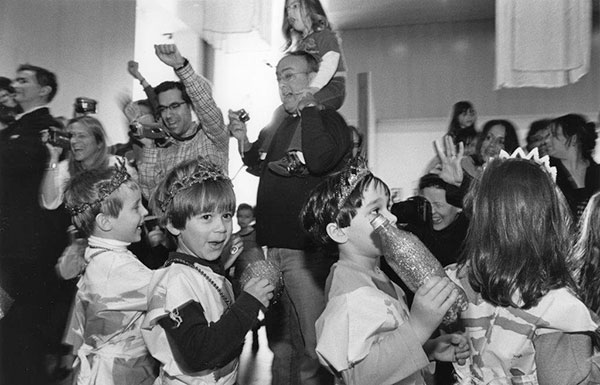
One program, the Jewish Multicultural Fall Family Festival, is held on a Sunday in November. This event, which seeks “to lift up and celebrate the diversity of the customs and traditions of our global Jewish community,” includes activity stations with music, crafts, storytelling and food. November was chosen to honor Mizrahi heritage month. In its inaugural year, partners included nineteen synagogues, Jewish community centers and cultural groups.[2]
Another program, Brooklyn Pride Shabbat, was catalyzed by a specific need identified by Senesh parents. Many Brooklyn Pride 2024 events were planned for Shabbat, making it problematic for Senesh to endorse participation by students and families. At the urging of Senesh’s LGBTQ+ parent affinity group, Maxner reached out to some of the organizations involved to brainstorm alternatives. She and parent leaders coordinated a Shabbat dinner in the school facilities. In addition to current Senesh families, new families enrolled for the 2024-2025 school year attended, as well as families from outside Senesh. Brooklyn Pride Shabbat was repeated in June 2025 and was also used as a model to set up a series of Shabbat dinners with a core group of partners highlighting different themes and groups throughout the 2024-2025 school year. Senesh also hosted the first community wide Jews of Color Havdalah service in February.
These examples highlight the porous boundaries between school and community. Events that were initiated by school administrative or parent leaders and held at the school both served the needs of school families and strengthened partnerships with community organizations. The events illustrate how a focus on one group, Jews of Color, works in tandem with efforts to support groups representing other aspects of Jewish diversity (Sephardi-Mizrahi and LGBTQ+). According to Senesh Diversity Advisory Council member Lindsey Newman, director of education at Be’chol Lashon,[3] the field of those working to support Jewish diversity is small, and it to the advantage of everyone involved to work together. Based on the commitment of Senesh’s leadership to collaboration and partnerships, Newman enthusiastically predicts that the school will become a hub for this work.
Parents Spearhead Diversity Initiatives
As another example of Senesh’s commitment to collaboration and inclusivity, professionals at the school welcome parents as partners. This dynamic is evident in the intentional school-based structures that encourage parent initiatives and through administrative receptiveness to parents with specific expertise to share. Formal institutional work with parents started with the formation of a Parent Diversity and Belonging Committee in 2018 and has expanded to the creation of affinity groups requested and led by parents, including LGBTQ+, JOC, interfaith and Sephardi-Mizrahi groups.
While multiple affinity groups were not part of the original diversity plan, once requested by the parents they were welcomed by the administration. As the parents’ main liaison to administration, Maxner shares that she has learned, “that it is ok” for people to separate at times from the whole based on shared identity in order to support each other. The ongoing evolution of the affinity groups illustrates that a culture of inclusivity can justify the dedication of resources to specific groups, because of the understanding that a stronger sense of belonging for members of these groups enhances the community for all. Several Senesh parents view the affinity groups as the focal point of their connection to the school community, from which their further participation efforts radiate, such as LBTQ+ Shabbat described above and individual parent contributions described below.
Dr. Imani Chapman, the founding member of Senesh’s Diversity Advisory Council, views affinity groups as an equity issue, explaining that certain groups need the kind of additional support that a separate safe space can provide. However, she recognizes the challenge of separating people by identities and advises Senesh to think about “how not to provoke envy among groups,” to clarify the role of the affinity groups (advocacy v. support) and to articulate a path for those who wish to consider joining (e.g., clarifying whose identity, parent or child, determines whether one should or could participate in an affinity group). Dr. Chapman recommends clear policies for communication in order to ensure consistency of experience across groups.
In addition to collaboration around affinity groups, Senesh welcomes parents to share expertise in programming. Often, Senesh parents are leaders of the organizations with which Senesh partners, and their contributions to Senesh events strengthen these partnerships. For example, before Purim Senesh parent and Kane Street Synagogue Rabbi Michelle Dardashti visited middle school students to share her family's story and talk about her Persian-Jewish heritage. Parent Naomi Rabeeya, a Hebrew Union College development professional, taught second graders an Iraqi-Jewish tune for Mah Nishtanah (the Four Questions) that her family has sung at their Seder for generations.
Senesh parent Rabbi Heather Miller, founder of The Multitudes, an organization dedicated to raising race consciousness, is a member of Senesh’s Diversity Committee and JOC affinity group. Rabbi Miller initiated the “Together We Win” program, a collaboration between Senesh and the Lamad Academy Charter School in Brownsville, Brooklyn. The program launched in Fall 2023 as an 8-week afterschool program with sponsorship from the National Black Empowerment Council (NBEC) and UJA Federation. It was open to 6th-8th graders from Senesh and Lamad as a pilot cohort of middle schoolers from Black and Brown communities and the Jewish community. Twelve students from each school met regularly to learn about each other’s cultures and histories and particularly the impacts of racism and antisemitism. The program included a joint trip to Washington DC to the U.S. Holocaust Memorial Museum and Memorial and the National Museum of African American History and Culture.
In 2024-2025, students from Senesh and Lamad Academy continued the partnership, as part of an “exploring Black and Jewish narratives” program. Faculty created an expanded version of an “Exploring Black Narratives” curriculum[4] with which 7th graders at Senesh had engaged previously. Although the Senesh-Lamad Academy partnership is not specifically focused on the experiences of Jews of Color, Rabbi Miller’s leadership and the participation of some Senesh students of color ensured their representation. This program is a crucial next step beyond speaking and learning “about” American diversity to interacting more regularly with people who hold different identities.
Rabbi Miller’s contributions underscore the multifaceted impact of valuing parents in the culture building process. Rabbi Miller has written and spoken publicly about frustrations with other day schools and their approaches to inclusion of her biracial children (2020). In contrast, Rabbi Miller shared her delight the first time she walked into her child’s Senesh classroom and realized that she was not the only parent of color. She explained that with 25% children of color in the class her child wouldn’t feel out of place. By creating a welcoming school environment that values parent contributions, Senesh gained an enthusiastic partner family.
Camp Kulam- a Deep Dive into Program Development for JOC
Important curricular lessons can also be gleaned from a case study of Senesh’s one-week vacation “Camp Kulam,[5] a “multicultural camp that celebrates global Jewish diversity [and] lifts up the experiences of Jews of Color.” As described on the school website, campers had the opportunity to “explore and feel proud of their own identities [and] celebrate and learn about Jewish cultures and communities around the world.”
Staffing is a significant element in creating an inclusive culture that celebrates diversity, as recruited camp staff all identified as JOC. Parents appreciated the diverse Jewish identities represented by the staff who, as in all camps, serve as role models. One notable staff member was a Senesh 6th grade student who identifies as JOC. Her mother, a member of the Diversity Committee, was excited to have her daughter participate as an intern as no similar experience had been previously available. Another parent spoke of a quickly forming bond between her normally shy, reserved child, and the counselors. Maxner shares that this relationship building is crucial: “not every activity” has to include more formal Jewish diversity content to project a message of inclusion as long as positive relationships are evolving among campers and between campers and staff.
Camp staff also valued their experience. Mostly young adults, they shared powerful narratives as Jews of Color during orientation. By providing opportunities for these young adults to hear validation of their heritage that they might not have experienced previously, to grow their own Jewish learning, and to increase their own sense of belonging, Maxner hopes they might begin to see themselves as emerging Jewish educators, particularly if more regular work opportunities can be offered. To this end, she recruited one camp staff member to work in Senesh’s after school program who then took a teacher assistant position.
The Senesh team and JOC families recognize that even with dedicated recruitment not all Jewish educational institutions will be staffed, even in part, by Jews of Color. Nevertheless, they point to intentionally inclusive spaces such as Camp Kulam as critical experiences for children of JOC families. It is important for them to see themselves and their families reflected in leadership, curriculum, and fellow campers, even if only for a short time. Experiences such as these add balance to their experiences in majority-White Jewish institutions.
The Challenge of Language and Labels
Like others in the field, Senesh stakeholders noted that “Jews of Color” as an umbrella term is both useful and problematic. On the one hand, they appreciate the term for calling attention to the diversity of the Jewish community. However, just as Jews are not a monolithic group, Jews of Color are not monolithic. At Senesh, JOC self-identify based on different histories: as the child of one or two parents of color, as Jews by choice, as Africans, Asians or Latinos, or as trans-racial adoptees. JOC may be lumped together as “non-white” in an American society that assigns racial identity in a unique way, but this essentialized racial identity may not be the main one with which JOC’s were raised. As noted, specifically some of Sephardi/Mizrahi descent, by way of Israel or other paths, often do not name themselves as Jews of Color and do not see themselves as separate from the white-identifying Jewish majority (Bitton, 2025). As Be’Chol Lashon’s Newman explains, “Jews of Color” is a socially created category that describes an experience, not a list of characteristics, and that experience is at the intersection of religion, ethnicity and race. All of these components need consideration when working towards an inclusive environment, throughout programming and marketing materials; there is no “one size fits all.”
Language issues extend to data collection and analysis. Maxner reports that during Camp Kulam’s pilot year the twelve campers come from backgrounds that are not neatly classified as “Jews of Color” or “white Jews.” Whose identity characteristics should be considered in demographic aggregations - the child’s, the parents’, or both? It is difficult to analyze data when parents can choose “all that apply.” By extension, it is challenging to evaluate the impact of the program overall for the target audiences since few generalizations will apply to the whole group. Maxner also shared that some parents felt the amount and nature of demographic questions on the camp application were burdensome, bordering on intrusive. This raises the challenge of how to build an intentional community that includes people of different backgrounds without instilling a sense of tokenism in those representing marginalized groups.
Sharing the Senesh Story
As their work continues, Senesh has prioritized sharing its experiences with the field by creating intentional spaces for connection, learning, and collaboration. Nash, Maxner and Chapman presented at the 2025 Prizmah day school conference, offering a practical framework for building spaces of belonging and elevating diversity, including tools and insights for launching and sustaining parent affinity spaces. Following Prizmah, Senesh designed a half-day in-person “Diversity and Belonging Workshop” for a cohort of New York day schools with the goal of deepening participating schools’ capacity to build and sustain diversity efforts in ways that are meaningful and mission-aligned. Participant feedback showed that school leaders are eager not only for frameworks and tools, but also for spaces of ongoing reflection, accountability, and support as they continue this essential work in a challenging political environment.
Senesh’s journey of developing and maintaining a culture of belonging is ongoing. While Nash declares firmly that inclusion has become organic, and “it’s just what we do,” the Senesh team acknowledges that it is her visioning and vigilance in shaping initiatives that actualize the school’s values that keeps the process moving ahead, as well as a willingness to take risks and experiment. While every school culture is unique, and Senesh’s exact model is not replicable, their innovative approaches of empowering parents and reaching beyond traditional school stakeholders to wider community partners offer fruitful starting points for elevating the voices of marginalized groups such as JOC. Redefining community as “within and beyond” is a crucial move to synergize creativity and energy to sustain a culture of belonging.
References:
Belzer, T., Brundage, T., Calvetti, V., Gorsky, G., Kelman, A., & Perez, D. (2021). Beyond the count: Perspectives and lived experiences of Jews of color. Jews of Color Initiative. Retrieved July 9, 2025 from BEYONDTHECOUNT.FINAL_.8.12.21.pdf
Berger, S. (2020). Jewish Word | Jews of Color
Bitton, M. Why I Am Not a Jew of Color – SAPIR Journal
Katz, M., Kress, J. & Uhrman, A (2024). Jewish Day School Educators’ Perceptions of How Their School Communities Engage with Race and Racism. The Collaborative for Applied Studies in Jewish Education (CASJE).
Jewish Educators on How School Communities Engage with Race/Racism | CASJE
Miller, H. (2020) We're All Helping Raise Black Jewish Kids – Kveller
Pomson, A., & Schnoor, R. F. (2008). Back to school: Jewish day school in the lives of adult Jews. Wayne State University Press.
Race, ethnicity, heritage and immigration among U.S. Jews | Pew Research Center
Rosen, The DEI Complex Will Never Protect Jews - Tablet Magazine;
Tremoglie, Are these Jewish organizations still supporting Black Lives Matter? - Washington Examiner
[1] Methodological and definitional differences result in a range of percentages. According to a 2021 Pew Study, “ 92% of U.S. Jews describe themselves as White and non-Hispanic, while 8% say they belong to another racial or ethnic group.”Race, ethnicity, heritage and immigration among U.S. Jews | Pew Research Center
[2] Partners included the American Sephardi Federation, AsefaMusic, Be'chol Lashon , Brooklyn Conservatory of Music, Brooklyn Heights Synagogue, Beth Shalom v'Emeth Reform Temple, Encore Music, Flatbush Jewish Center, JCC Brooklyn, JIMENA: Jews Indigenous to the Middle East and North Africa, Kane Street Synagogue, New York Andalus Ensemble, Park Slope Jewish Center, PJ Library in New York, Repair the World Brooklyn, Sephardic American Mizrahi Initiative - SAMi, Sephardic Mizrahi Q Network, Sprout Brooklyn Day Camp, and The Multitudes.
[3] Be’Chol Lashon, (literally, “in every language”) headquartered in San Francisco, has pioneered the celebration of multicultural Jewish life through educational programming and research since its founding in 1988.
[4] The program is designed specifically for Jewish day schools. It brings a team of teaching artists of color to introduce Black narratives through literature, interviews and performance. Our-program — Exploring Black Narratives
[5] Senesh piloted “Camp Kulam” in 2023 and 2024 during February break week for New York City public schools and some private schools.
Meredith Katz is a doctoral lecturer in the Secondary Education and Youth Services (SEYS) program in social studies education at Queens College (City University of New York). She recently completed twelve years as Clinical Assistant professor of Jewish Education in the William Davidson School of Jewish Education of The Jewish Theological Seminary. Meredith also serves as faculty for the Jewish Court of All Times online simulation program for Jewish day schools, previously funded generously by the Covenant Foundation. Meredith’s current research interests include citizenship education in Jewish schools, particularly as it relates to the teaching of Jewish history and schools’ efforts to engage with issues of diversity.

Latest Volumes
Past Volumes













Built On the Roots of Tradition: New Models in Jewish Supplementary Education